OSINT Briefing Southwest 5
OSINT Briefing // Operational Sector: Lesser Poland Gap – Krakow Axis [50.061° N, 19.936° E]
Subject: Catastrophic Collapse of 11th Combined Arms Army (11CAA) and Uncoordinated Withdrawal Toward Krakow
Classification: Strategic Assessment / Verification of Total Operational Dissolution
Kinematics of Decomposition: Transition from Retrograde to Rout
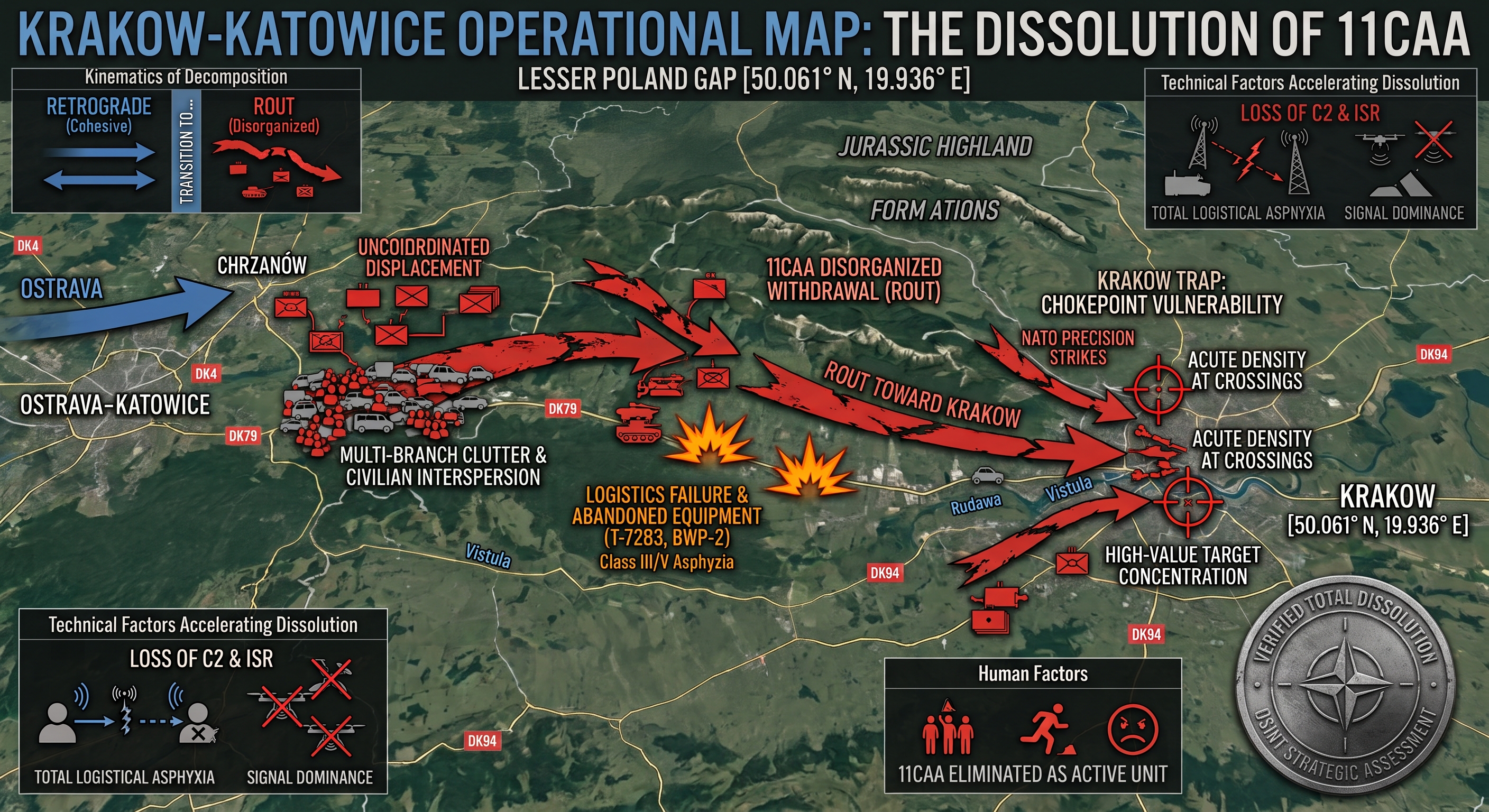
Satellite telemetry, ground sensor logs, and social media intercepts confirm the 11th Combined Arms Army (11CAA) is no longer a functioning military entity. NATO’s Counteroffensive along the Ostrava-Katowice corridor has precipitated a total structural collapse, forcing uncoordinated movement eastward along the DK4 and DK79 axes toward Krakow.
-
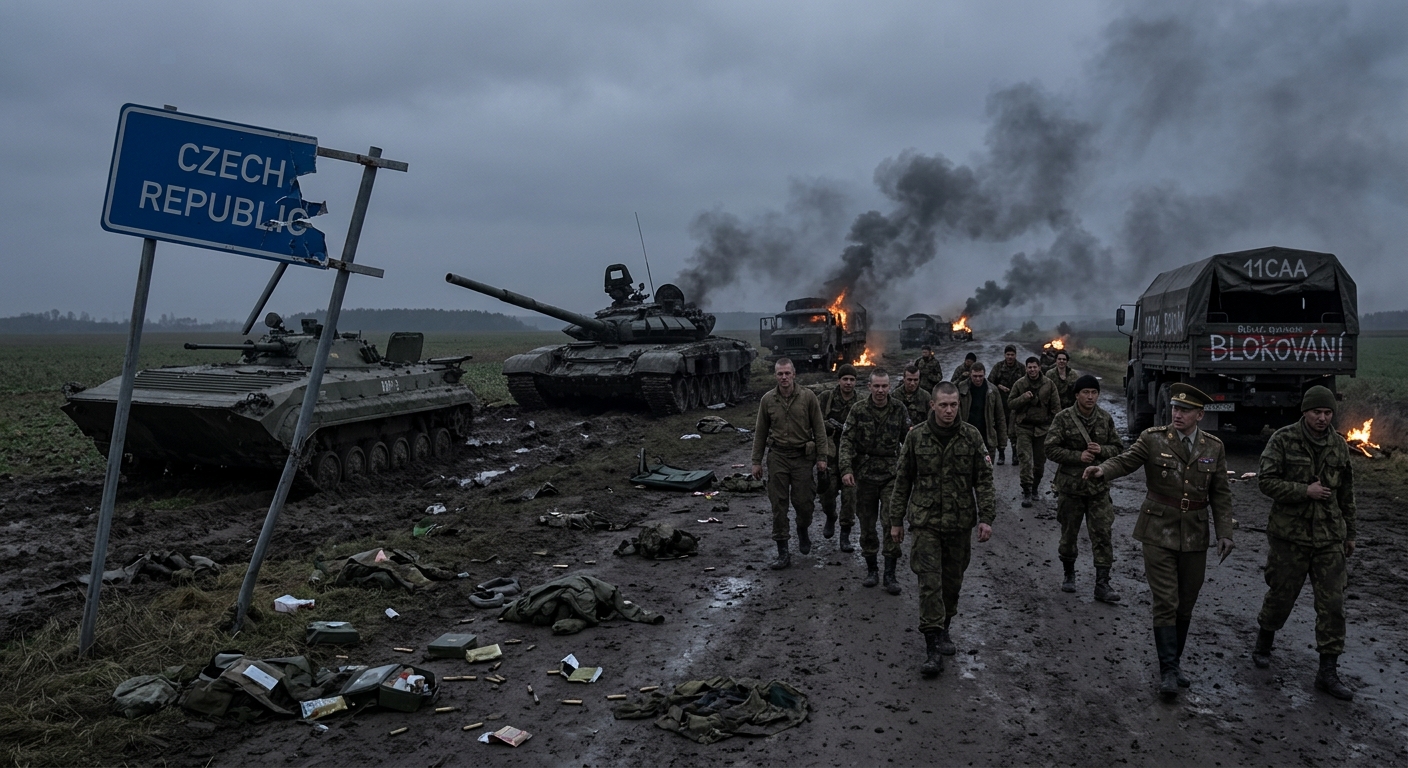
Operational Status: Disorganized Displacement (Rout): 11CAA has transitioned from a retrograde operation to a generalized panic. There are no distinguishable cohesive formations; instead, multi-branch elements (armor, motorized infantry, and logistics units) are identified interspersed with civilian traffic, clogging all secondary road networks between Chrzanów and Krakow.
-
Loss of Command and Control (C2): Operational cohesion is zero. Signal traffic demonstrates the disappearance of high-level divisional netting. Forward units are operating completely detached from supporting echelons, making simultaneous, synchronized defensive maneuvers impossible.
-
Extraction of High-Value Assets: Significant focus is observed on the prioritization of C2 elements and specialized electronic warfare (EW) hardware for extraction, leaving frontline units to filter backward along unpaved tracks and canalized routes.
Technical Factors Accelerating Dissolution
The collapse was catalyzed by the simultaneous suppression of critical enabling subsystems, rendering 11CAA blind, deaf, and static:
-
Total Logistical Asphyxia: As of T-12 hours, 11CAA forward elements are completely disconnected from Class III (fuel) and Class V (ammunition) resupply lines. The loss of the central Katowice rail terminal has neutralized the army’s sustainment architecture. Ground telemetry verifies multiple instances of functional T-72B3 and BWP-2 platforms abandoned along Route 79 due to fuel exhaustion, a primary signature of logistics failure.
-
Suppression of ISR and Unmanned Systems: NATO formations have achieved complete local signal dominance. 11CAA has lost its persistent intelligence, surveillance, and reconnaissance (ISR) and unmanned aerial system (UAS) capability. This was achieved through:
-
Kinetic Targeting: Successful deep-penetration strikes against established tactical drone hubs.
-
Electronic Warfare: Continuous signal attenuation along UHF/VHF frequencies, rendering tactical data links (e.g., Orlan-10 control channels) inoperable.
-
-
Targeting Latency Inversion: Retreating units are moving without tactical intelligence. NATO fires complexes are processing 11CAA movement at near-real-time rates, generating lethal congestion along the extraction funnels.
Spatial Dynamics of Attrition: The Krakow Trap
Krakow, originally intended as a logistical secondary echelon point, has become a spatial bottleneck for 11CAA’s uncoordinated flight.
-
Chokepoint Vulnerability: The converging road network (DK94/DK7) creates acute density at bridge crossings over the Rudawa and Vistula drainage systems. This density, combined with the mix of damaged military and fleeing civilian traffic, creates high-value target concentrations for NATO precision strike packages.
-
Terrain Canalization: Retreating units are forced through narrow gaps between the Jurassic Highland formations to the north and the Vistula floodplains to the south. This restricts maneuver and exposes retreating columns to sustained flank interdiction from NATO special operations forces (SOF) and mobile ATGM teams.
-
Infrastructure Contamination: To mask their flight, some rearguard units are implementing scorch-earth tactics on transport infrastructure. This is functionally irrelevant against NATO air dominance but is significantly degrading civilian evacuation routes.
Human Factors: Uncontrolled Attrition and Morale Dissolution
The mental degradation of 11CAA personnel is now a self-reinforcing tactical factor:
-
Low Morale Index: Intercepted traffic indicates severe fragmentation, insubordination, and high desertion rates. Units are abandoning equipment to improve movement speed, prioritizing individual survival over mission cohesion.
-
Uncoordinated Attrition: Without ISR and with C2 fractured, units are blundering directly into established ambush zones. 11CAA is sustaining unsustainable personnel losses because they cannot generate defensive depth or coordinate fire support.
Strategic Conclusion: The 11th Combined Arms Army has suffered total operational decomposition. There is no residual combat capability remaining for a cohesive defense, localized counterattack, or organized extract. 11CAA is effectively eliminated as an active order-of-battle component. Its remaining strength is being systematically neutralized within the Krakow-Katowice corridor. Future analysis shifts to the impact of this vacuum on the wider Western Axis.